In 2018 I co-founded Dapper, a Growth Agency in Rotterdam. Over the next 5 years we grew from 2 to 40 people. Along the way I learned something that surprised me: building a great culture wasn't about ping-pong tables, an office dog or office parties. The real secret is doing a handful of simple things consistently.
These are the seven lessons I wish someone had told me from the start. No theory. Just what actually worked.
In this post
- Why chasing work-life balance might be the wrong goal
- The one book that changed how I handle difficult conversations
- What breaks at every stage of growth (and what to do about it)
- How anonymous feedback changed our culture overnight
- Why your best performers will leave if you do not give them this

Here is the thing nobody tells you when you start a company: your job changes completely every time you add a handful of people. At 5 people I was doing the work. At 15 I was managing people doing the work. At 30 I was managing the people who managed the people. And by 40, I was mostly designing systems and trying to keep the culture alive.
Every stage breaks something. What worked at 10 stops working at 20. The informal "we all just know what's going on" vibe dies somewhere around 15. Your first real management crisis hits around 30. And somewhere after 50, people join who have never met you and don't know why you started this thing in the first place.
I mapped out these phases below because I wish someone had shown me this before I lived through it. If you know what is coming, you can prepare. Or at least panic slightly less.
The founder journey
How your role changes as you grow
Your job at 5 people looks nothing like your job at 50. Here is what shifts at each stage and what to do about it.
You do everything. Sales, product, hiring, fixing the printer. There is no structure because there is no need for it yet.
What breaks
Nothing. This is the fun part.
What to do
Enjoy it. But start writing things down.
You can't do everything anymore. You need to trust others with work you used to own. This is where most founders struggle for the first time.
What breaks
Communication. Things fall through the cracks because "everyone just knew" no longer works.
What to do
Have your first real one-on-ones. Start a weekly rhythm. Give feedback even when it feels awkward.
You're no longer leading individuals. You're leading people who lead people. The distance between you and the work grows. You hear things secondhand.
What breaks
Culture. The unspoken rules that worked at 10 people don't survive 25. You need to make them explicit.
What to do
Run your first pulse surveys. Start performance reviews. Build the feedback loops before you desperately need them.
Your job is no longer about the work. It's about designing the system that produces the work. Org charts, processes, career paths.
What breaks
People outgrow their roles. Your early hires may not be the right fit for what the company needs now. This is painful.
What to do
Create real structure. Goals, review cycles, growth paths. The people stuff you keep postponing? This is when it catches up with you.
At this point, culture either runs on autopilot because you built it well, or it runs on chaos because you didn't. New hires don't know the origin stories. They only know what they experience.
What breaks
Identity. The company feels different. You feel different in it. Some of that is natural. Some of it means you lost something along the way.
What to do
Measure what matters. Listen systematically. And keep having the conversations that got you here.
The doer
1-5You do everything. Sales, product, hiring, fixing the printer. There is no structure because there is no need for it yet.
What breaks
Nothing. This is the fun part.
What to do
Enjoy it. But start writing things down.
The first-time leader
5-15You can't do everything anymore. You need to trust others with work you used to own. This is where most founders struggle for the first time.
What breaks
Communication. Things fall through the cracks because "everyone just knew" no longer works.
What to do
Have your first real one-on-ones. Start a weekly rhythm. Give feedback even when it feels awkward.
The manager of managers
15-30You're no longer leading individuals. You're leading people who lead people. The distance between you and the work grows. You hear things secondhand.
What breaks
Culture. The unspoken rules that worked at 10 people don't survive 25. You need to make them explicit.
What to do
Run your first pulse surveys. Start performance reviews. Build the feedback loops before you desperately need them.
The org architect
30-60Your job is no longer about the work. It's about designing the system that produces the work. Org charts, processes, career paths.
What breaks
People outgrow their roles. Your early hires may not be the right fit for what the company needs now. This is painful.
What to do
Create real structure. Goals, review cycles, growth paths. The people stuff you keep postponing? This is when it catches up with you.
The culture keeper
60-100At this point, culture either runs on autopilot because you built it well, or it runs on chaos because you didn't. New hires don't know the origin stories. They only know what they experience.
What breaks
Identity. The company feels different. You feel different in it. Some of that is natural. Some of it means you lost something along the way.
What to do
Measure what matters. Listen systematically. And keep having the conversations that got you here.
Based on Greiner's Growth Model, Dunbar's Number research and a lot of personal experience.
The seven lessons that follow are the things that helped me through every single one of these phases. Some I learned early. Most I learned too late. They are also the reason I eventually built nodo, but more on that at the end.
1. Don't overthink balance. Congruence is what it's all about.
Everyone talks about work-life balance. Draw a clear line between work and life. Protect your evenings. Don't answer emails after 6pm.
At first this sounds like the right thing to do. But there is something fundamentally wrong about it, which is that work will always get the label "bad" and free time "good". And that is just a waste, because who actually wants to spend most of their days doing something bad? This counts for both you and your employees.
So I stopped chasing balance and started focusing on congruence. Can I be the same person at work that I am at home? Can I do things that I enjoy? Can my team do the same? That became the real question.
The goal isn't balance. The goal is congruence. Being able to do things that are authentically you, whether it´s at home or at work.
Once I framed it that way, it changed everything. I stopped asking "are we protecting people from work?" and started asking "are we creating a place where people can be themselves?" Not a watered-down, corporate proof version of themselves. Their actual selves.
That shift changed how we hired, how we managed and what we tolerated. When people feel like there is no gap between who they are and who they pretend to be, they bring more energy, more creativity and more commitment. You can't mandate that. But you can create the conditions for it.
2. Have the crucial conversations.
There's a book called Crucial Conversations by Patterson, Grenny, McMillan and Switzler. It changed how I think about leadership more than any other book. The core idea is simple: the quality of your relationships and results depends on how you handle the conversations where the stakes are high, opinions differ and emotions run strong.
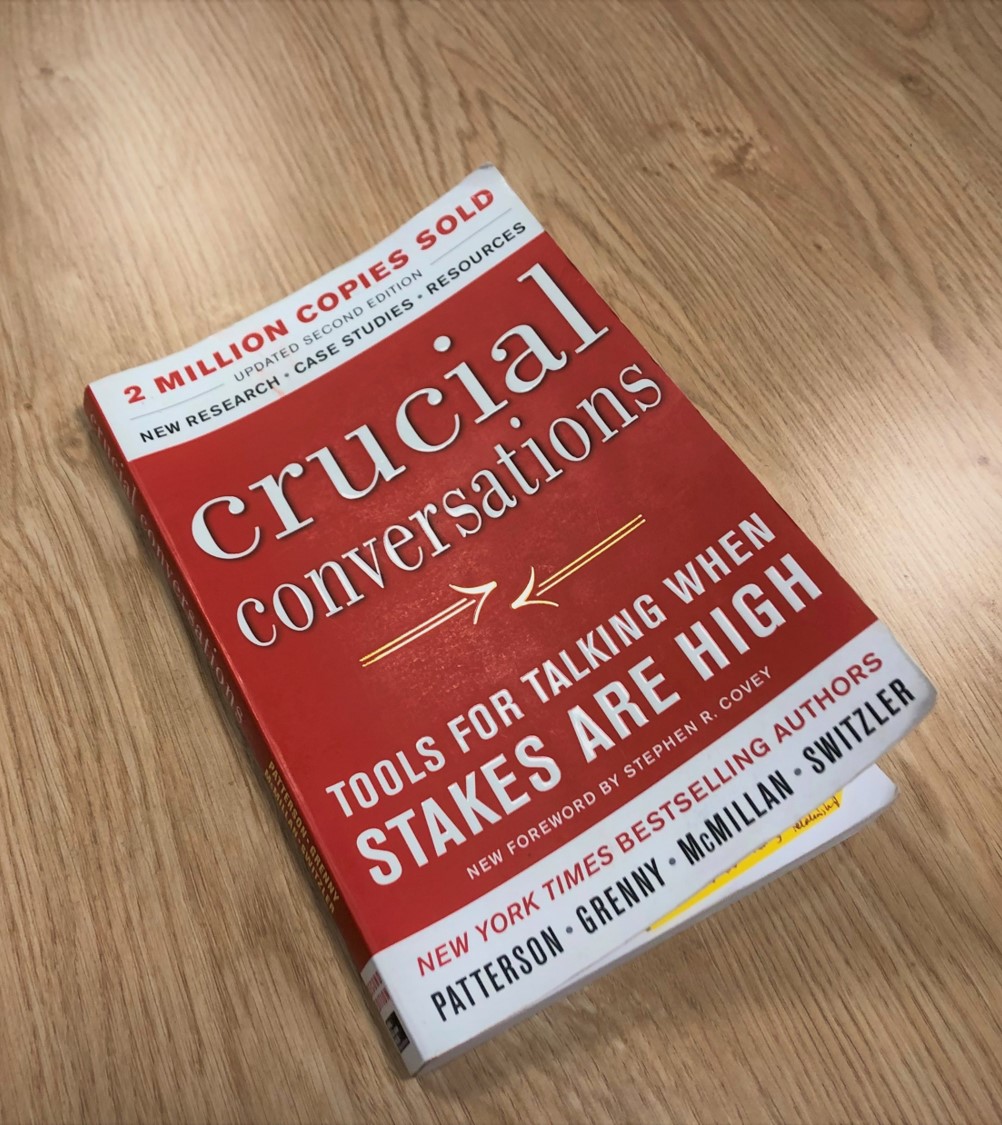
Before reading it, I avoided those conversations. A team member underperforming? I'd give it another month and hope it improved. Two people in conflict? I'd convince myself it would sort itself out. A client relationship going sideways? I'd work around it instead of addressing it head-on.
The book has this concept they call the Fool's Choice. It is the belief that you only have two options:
- Speak up and destroy the relationship.
- Stay silent and keep the peace.
Most founders I know live in this trap. You think: if I give this person honest feedback, they will resent me. So you say nothing. Or you blow up six months later when the frustration has been building.
The whole point of the book is that there is a third option. You can be completely honest and completely respectful at the same time. That is what a crucial conversation actually is. Not choosing between honesty and kindness, but doing both.
The problem is that every crucial conversation you avoid becomes a problem you carry. The tension doesn't go away. It compounds. And your team notices. They notice when you don't address the person who's consistently late. They notice when you avoid the conversation about a project that's clearly failing. Your avoidance becomes the culture.
Every crucial conversation you avoid becomes a problem you carry. Your avoidance becomes the culture.
I started forcing myself to have these conversations within 48 hours. Not perfectly. I was terrible at it in the beginning. But just doing it, even clumsily, was infinitely better than pretending the issue didn't exist. And the more I practiced, the more I realized the Fool's Choice really was a fool's choice. The conversations I dreaded the most usually ended up strengthening the relationship, not breaking it.
Structured review cycles give you a natural moment to have these conversations. Instead of finding the right time, you build it into the rhythm.
3. Give psychological freedom.
Google's Project Aristotle found that the single most important factor in high-performing teams was psychological safety. But I want to take it a step further. It's not just about safety, making people feel they won't be punished for speaking up. It's about freedom. Making people feel they should speak up. That their voice matters and is actively wanted.
At Dapper, we made it a point that anyone could challenge any idea in any meeting (us being Dutch did help with this). It didn't matter if you were an intern or a manager. If you saw a problem, you were expected to name it. Not in a "let's play devil's advocate" way. In a genuine "we want your perspective because it makes us better" way.
This is harder than it sounds because it requires the founder to go first. You have to model being wrong. You have to say "I don't know" in rooms where everyone expects you to have the answer. You have to thank someone publicly for disagreeing with you.
When we got this right, the quality of our work improved noticeably. People caught problems earlier. They proposed ideas they'd previously kept to themselves. And they felt more ownership because they weren't just executing someone else's vision. They were co-creating it.
4. Engagement is a practice, not a program.
A lot of founders treat engagement like a project: you launch an initiative, run it for a quarter and check the box. A team outing. An offsite. A Slack channel for random. That's not engagement. That's entertainment.
Real engagement is a consistent practice. It's what you do every month, every quarter, every day. At Dapper, we built a few rituals that made a real difference:
- Monthly updates: Every month we organized a transparent update meeting to the whole team about how the company was doing. Revenue, pipeline, wins, challenges. No sugarcoating. People appreciated knowing the truth. And they were able to ask any questions they wanted.
- Company Retrospectives: Also every month, we would come together as a company and discuss together what went well, what we learned and what could be better. This lead to valuable discussions that everybody could participate in.
- Quarterly themes: Each quarter had a theme that tied our work to something bigger. It gave people a sense of direction beyond their daily tasks.
The recruitment safari
One quarter, when we wanted to focus on hiring, we brought the whole team into the process. Everyone searched in their network for new team members and when we reached our goal (we did) we would go on an actual safari in the Netherlands (Beekse Bergen). That way it was not only the goal of us as founders, but of the entire team.
None of these were expensive or complicated. They just required consistency. And consistency is the thing most founders struggle with because there's always something more urgent to do.
I built nodo for exactly this.
Keeping up with monthly feedback gathering for retrospectives, quarterly reviews and goal tracking is hard when you're running everything else. nodo handles the structure so you can focus on the conversations that matter. Try it free for 14 days.
5. Give people a voice (and actually listen).
This might be the most important lesson. You can create all the psychological safety in the world, but if people don't have a structured way to share how they feel, most of them won't. Not because they don't trust you. Because they're busy, or they don't want to seem like they're complaining, or they assume someone else will bring it up.
At Dapper, I learned this the hard way. I thought our flat organization structure and open plan was enough. "You can tell me anything!" I'd say. But not everyone did. Not because they were afraid, but because the barrier was too high. Walking to my desk in the office to say "I'm not feeling great about how things are going" takes courage that most people won't summon on a random Tuesday afternoon.
We started running anonymous pulse surveys. Short, regular check-ins that took two minutes to fill out. The results were eye-opening. Things I never would have heard in a meeting or a one-on-one came through loud and clear. And because it was anonymous, people were honest in a way they'd never be face to face.
An open-door policy is not a listening strategy. You need a system that makes it easy and safe for people to speak up.
The key was acting on what we heard. Not only analyzing the results, but actually showing things we'd change. That closed the loop. People saw that their feedback led to action, which made them more willing to share next time.
This is exactly what nodo's pulse surveys do. Anonymous, regular check-ins with trend tracking so you can see how your team is really feeling over time.
Pulse survey template
Pulse survey template
Free download: Pulse Survey Template
A collection of 33 research-backed questions we use in nodo, organized by theme. Ready to copy and send.
6. Set people up for growth.
Here's something I got wrong early on: I assumed that if people were doing good work, they were happy. I didn't realize that even your best performers need to feel like they're growing. They need goals to work toward, feedback on how they're doing and a clear picture of what "great" looks like.
At Dapper we always worked with personal plans (the bigger picture of what someone wanted to work towards) and we did performance reviews. In the early days, when the team was small, feedback happened naturally. You would see someone struggle in a meeting, and you could talk to them about it right after. Feedback was instant and specific because you were close to the work.
But as the team grew past 15 people, that stopped working. We became less and less aware of what was happening on the work floor. Things would go wrong that we only heard about weeks later. Feedback that used to be timely started coming too late, or not at all.
We had to change our approach. Instead of relying on what we happened to notice, we needed to capture feedback in a structured way. And the feedback itself had to get better too, because the expectations of our employees grew. When you have 5 people, a casual "hey, nice job on that project" goes a long way. When you have 30, people want to know where they stand. They want real conversations about their growth.
Once we made that shift, the entire team benefited. People started improving more and more. They became hungry during the year to do something with the feedback they received. Even though it remained difficult to organize and share high-quality feedback, it paid itself back big time.
Past 15 people, you need a system for feedback. Otherwise it becomes a mess and people stop growing.
nodo gives you structured review cycles, goal tracking and peer recognition. All in one place, set up in minutes.
Performance review guide
Performance review guide
Free download: Your First Performance Review Guide
A step-by-step guide for running your first review cycle. Questions, timeline and tips included.
7. Leave room to play.
I almost didn't include this one because it sounds like a cliche. "Have fun at work!" Great, thanks, very helpful.
But here is what I mean. The best moments at Dapper were never planned. The inside jokes that became part of how we talked to each other. The spontaneous celebrations that happened because we genuinely wanted to, not because someone put them on a calendar. Someone once came up with the idea to organize potluck dinners. No business reason. Just: why not? So we did. And those dinners became something people looked forward to for months.
That is the kind of thing that happens when you give space for any idea. It does not matter if it is about the business or about something completely random you can do as a team. What matters is that the space exists. That people feel like they can throw out a crazy idea without someone immediately asking "but what is the ROI?"
People like to play around. That is just human nature. And when they get to do that at work, they enjoy being there more. It is that simple. The problem is that most companies squeeze it out. Every hour gets filled. Every week gets optimized. And suddenly there is no room left for the stuff that makes work feel like more than just a job.
As a founder, you set the tone. If you are always busy, always rushing between meetings, your team will feel like they should be doing the same. But if you are the one who says "let's do it", if you show up to the potluck dinner, if you take the random ideas seriously, people notice. And that is when the culture starts to feel different.
People like to play around. When they get to do that at work, they enjoy being there more. It is that simple.
Why I built nodo.
After leaving Dapper, I kept coming back to the same question: why is it so hard for founders to do the basics of people management?
I thought about the time I was sitting in the Dapper office at 15 people, realizing I had lost touch with how the team was actually feeling. About the crucial conversations I avoided for months because there was no natural moment to have them. About the people who quietly disengaged because nobody asked how they were doing. About the feedback that came too late because we had no system to capture it.
Most founders care deeply about their teams. The problem is not motivation. It is that the tools available are either designed for enterprises with HR departments, or they are so basic they do not actually help.
I created the tool I wished I had had at Dapper. Something that makes it easy to run a pulse survey, track goals, do reviews and keep a simple org chart. Without needing an HR person and without enterprise pricing. So you can spend less time on processes and more time with your team.
That is nodo. It is built for founders and team leads who handle people operations alongside everything else. If any of these lessons resonated with you, I would love for you to give it a try.
Here is a 3-minute overview of how it works: